
How to Use EGX30, EGX70, and EGX100 for Market Analysis?
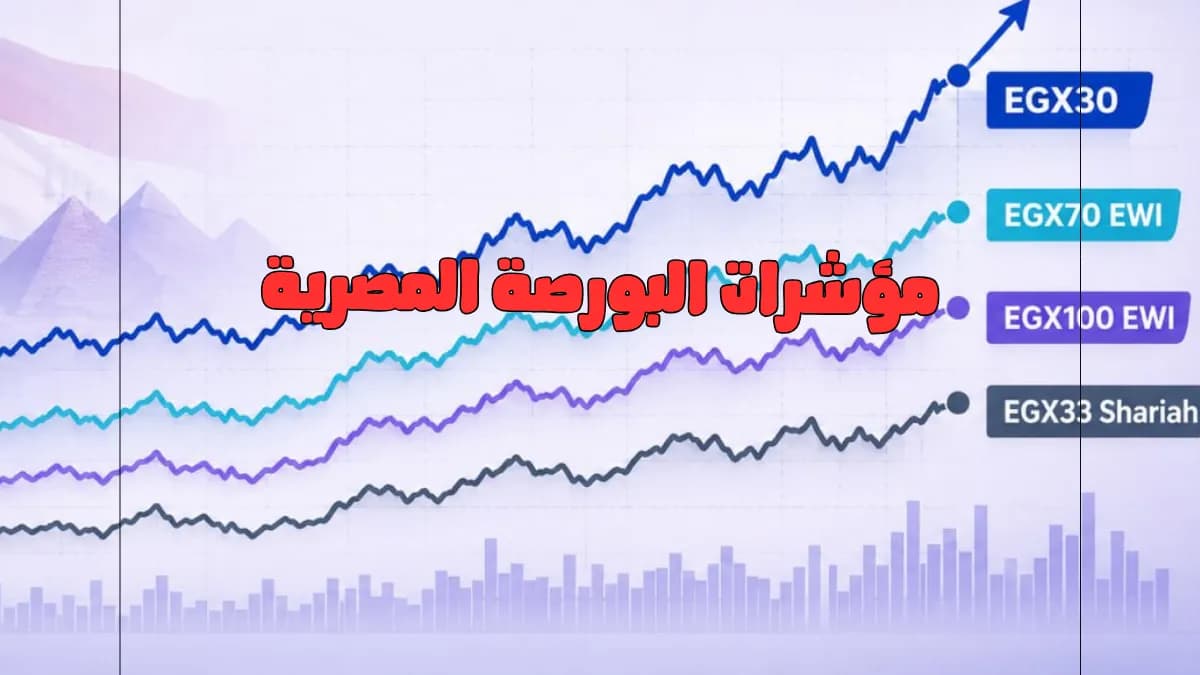
If you follow the Egyptian stock market, the first index you’ll probably come across is the EGX30.
Is the market going up? We look at the EGX30.
Is the market going down? We still look at the EGX30.
But the problem is that relying on just one index can give you only part of the picture.
The Egyptian stock market isn’t made up of a single stock, and not all stocks move with the same strength or at the same time.
You might find the EGX30 making new highs while a large number of stocks aren’t moving higher with it.
And the opposite can happen too: mid- and small-cap stocks may be moving strongly while the large leading stocks remain relatively quiet.
That’s why, if you want to read the Egyptian market more effectively, don’t look at the stock alone.
Look at the market first… then move down to the stock.
There are many indices you can follow, but if your goal is to analyze market and stock movements, I believe the most important ones to start with are:
EGX30 – EGX70 EWI – EGX100 EWI – EGX33 Shariah
Each one gives you a different part of the overall picture.
1. EGX30 Index
This is the main index of the Egyptian Exchange, and it includes some of the largest, most active, and most liquid companies in the market.
So when you hear that “the Egyptian stock market is up” or “the main index declined,” the discussion is usually referring to the EGX30.
But there’s an important point to keep in mind:
A rising EGX30 doesn’t necessarily mean that the entire market is going up.
A limited number of large-weight stocks can drive the index higher while the rest of the market performs much more weakly.
That’s why, for me, the EGX30 alone isn’t enough to get a complete picture of the market.
2. EGX70 EWI Index
Here, we start to see a different part of the market.
The EGX70 EWI includes 70 companies outside the EGX30 components, giving you a better view of a broader segment of mid- and small-cap stocks.
The term EWI stands for Equal Weighted Index.
Simply put, the index gives its constituents equal weights, so the movement of a single company doesn’t have the same ability to dominate the index as it might in a market-cap-weighted index.
That’s why following the EGX70 alongside the EGX30 can tell you something very important:
Where is the liquidity?
Is the market movement concentrated in the leading stocks?
Or is liquidity starting to flow more strongly into mid- and small-cap stocks?
3. EGX100 EWI Index
The EGX100 gives you a broader view of the market.
It combines the companies included in the EGX30 and EGX70 into a single index, giving you a more comprehensive look at the performance of a large group of active stocks in the market.
For me, this is useful when I want to know:
Is the move I’m seeing actually a broad market move?
Or is it just a limited group of stocks that’s driving the move?
The EGX30 might be performing very strongly, but when you look at the EGX100, you may discover that the broader market isn’t nearly as strong.
And this is where the information becomes more important than simply seeing whether the index is “green” or “red.”
4. EGX33 Shariah Index
If your focus is on Shariah-compliant stocks, this is where the EGX33 Shariah comes in.
The index gives you a benchmark that you can use to track the performance of a group of companies that meet the index’s Shariah criteria.
This means that instead of comparing a Shariah-compliant stock only against the broader market, you also have an index that is more representative of the type of stocks you’re interested in.
But it’s important to understand that a company being included in a Shariah index doesn’t eliminate the need to review the relevant standards and financial data yourself if Shariah compliance is an essential part of your investment decision.
This is where things actually get important.
Because memorizing the names of these indices won’t add much value by itself.
The real value comes from comparing them.
Let’s look at a few simple scenarios.
### EGX30 Strong + EGX70 Strong + EGX100 Strong
Here, the market move is more broadly distributed.
Large-cap stocks are moving, mid- and small-cap stocks are participating, and the broader index is confirming the same direction.
Overall, this gives you a stronger picture of market breadth.
### EGX30 Strong + EGX70 Weak
Now things look different.
Large-cap stocks may be carrying the market while mid- and small-cap stocks aren’t participating with the same strength.
If you only look at the EGX30, you might say:
“The market is extremely strong.”
But once you compare the indices, the picture starts to change.
### EGX70 Strong + EGX30 Weak
This could indicate that liquidity is moving more toward mid- and small-cap stocks.
And this can be particularly important for traders, because the opportunities in the market at that point don’t necessarily have to be in the leading stocks you see in the EGX30.
### EGX30 Makes a New High While the Other Indices Don’t Confirm It
This is where, for me, things start becoming worth watching closely.
Imagine the EGX30 keeps rising and making new highs, while the EGX70 or EGX100 can’t do the same.
The question becomes:
If the market is really this strong, why isn’t the rest of the market participating?
That doesn’t mean the market has to fall.
And it doesn’t mean every divergence is a signal to sell immediately.
But it’s an additional piece of information that you can add to your analysis and use to monitor whether the strength of the move is actually broad-based or starting to weaken.
### Don’t Look at the Stock Alone
This is one of the most important ideas that I believe can make a difference when trading the Egyptian market.
Before analyzing the stock, try to understand the environment that the stock is moving in.
Instead of opening a stock chart and immediately looking for an entry, ask yourself first:
Then move down to the stock itself.
You might have a stock with an excellent technical setup, but the sector it belongs to is weak and the overall market isn’t supportive.
On the other hand, you might find a stock with a less-than-perfect setup, but the market and its surrounding sector have very strong momentum.
The index doesn’t give you a ready-made trade.
It gives you context.
And that’s a big difference
I’ve traded the Egyptian stock market, tested SMC on it, and compared it with other markets as well.
In the end, I didn’t like it as a trading market for my particular approach.
And this is an important point: this is based on my own trading style, not a judgment on the market itself.
That doesn’t mean the Egyptian market is bad or that you can’t make money from it.
The Egyptian market is like any other market…
If you master it, you can learn how to profit from it.
If you gain enough experience with it and understand its behavior and how liquidity moves between its stocks and sectors, you can take advantage of its price movements.
But if you enter without understanding its nature, you can lose money just as easily.
Personally, my issue with it is that I don’t find trading it rewarding enough compared with other markets I’ve traded.
Saudi Market 🇸🇦 > US Market 🇺🇸 > Egyptian Market 🇪🇬
Especially when it comes to SMC, the Saudi market has worked best for me.
But this is a personal ranking based on the trading and analysis approach I use, not a ranking of the best stock markets overall.
Another trader using a different strategy could rank them completely differently.
This is a particularly important point when it comes to the Egyptian market.
When you see a stock or index rising significantly over a long period, you can’t always assume that the entire increase represents real growth in the same sense.
Companies may have:
* Assets linked to foreign-currency values.
* Export revenues.
* Products priced based on global prices.
* Land, real estate, or inventory whose nominal value has increased in Egyptian pounds.
* Revenues or costs that are directly or indirectly affected by exchange rates.
As the currency’s purchasing power declines, assets can also be repriced in Egyptian pounds.
So part of a stock’s rise may reflect genuine growth in the company.
And another part may simply reflect changes in the value of the Egyptian pound itself.
That’s why, when analyzing the Egyptian market over the long term, don’t look at the index’s nominal price alone.
The broader economic context matters.
If I were analyzing the Egyptian market, I wouldn’t just open the EGX30 and draw a couple of lines on it.
I’d start from the top and work my way down:
EGX30 → EGX70 → EGX100 → Relevant Index/Sector → Stock
And I’d compare them with each other.
Then I might add:
Trading Volume – Liquidity – Market Breadth – Sector Strength – Relative Strength – Performance of Leading Stocks
At that point, instead of asking the simple question:
“Is the stock market going up or down?”
You’ll have much more important questions:
Is the rally broad across the entire market?
Or are just a few stocks carrying the index?
Is liquidity flowing into large-cap or small-cap stocks?
Are the indices confirming each other?
Is there any Divergence?
Which sector is stronger than the overall market?
And which stock is stronger than its own sector?
This is where market indices stop being just numbers displayed on your screen…
And become tools that help you select stocks and determine timing.
And in my opinion, that’s the real purpose of using market indices.
Conclusion
If you trade in the Egyptian stock market, don’t let your analysis start and end with the stock itself.
Start with the market.
Follow the EGX30, EGX70 EWI, and EGX100 EWI, and if you’re interested in Shariah-compliant stocks, add the EGX33 Shariah to your analysis.
But more important than following each index separately is:
Compare them with each other.
Look at which one is leading the move, which one is lagging, where liquidity is flowing, and whether the broader market is confirming the movement of the main index.
And finally, remember:
The index won’t tell you to buy a specific stock.
But it can help you answer a much more important question:
Is the environment the stock is moving in actually suitable for me to look for an opportunity?