
Position Sizing: Calculate Trade Size from Your Stop Loss
When you say, “I’m buying with 20% of my portfolio,” you have told me your allocation. You have not told me how much you would lose if the trade fails.
Isn’t that 20% the risk?
No. There is a difference between the value of what you buy and the loss you plan to accept up to your stop. To calculate position size, you need your stop-loss level and the amount you are prepared to lose. Then you work out the quantity that fits both.
Let’s walk through an unleveraged spot purchase.
The same purchase amount can carry different risk
Your portfolio is $1,000. You buy $200 worth of an asset at $100, giving you two shares or coins. If the stop is at $95 and the sale executes there, each share or coin loses $5.
The total loss is $10, or 1% of your portfolio. You allocated 20%, but your planned risk was 1%.
What if you make the same $200 purchase, but your stop is at $90? The loss becomes $20, or 2% of the portfolio. The purchase amount did not change; the stop distance changed the risk.
That is what gets missed when your only question is, “What percentage should I put in?” The answer is incomplete without the level that invalidates your trade idea.
The position-sizing formula
For this purchase example:
Quantity = amount at risk ÷ difference between entry and stop.
If your planned loss is $10, your entry is $100 and your stop is $95, the quantity is 10 ÷ 5 = two units. The purchase value is two units × $100 = $200.
You can also calculate the purchase value directly:
Purchase value = amount at risk ÷ stop distance as a decimal.
The stop distance here is 5 ÷ 100 = 5%, or 0.05. So the purchase value is 10 ÷ 0.05 = $200.
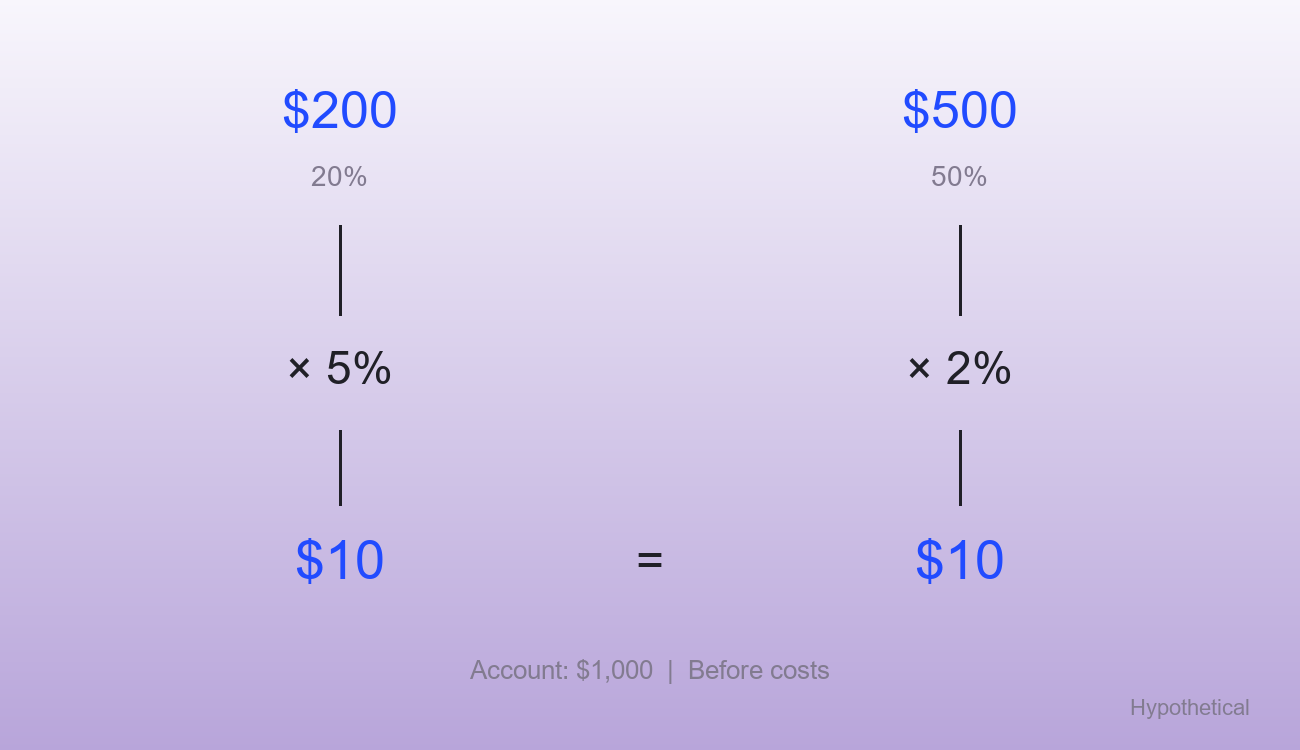
If another trade has a technically justified stop 2% away, the same loss budget gives a $500 purchase. Your allocation changed, while your planned loss stayed the same.
That does not make the larger purchase better. The size must fit your available cash and portfolio allocation limits. If the calculation exceeds your limit, reduce the position or skip the trade. You do not have to use your entire risk budget.
Do not move the stop closer just to like the calculation
You might look at the example and think: great, the closer my stop, the more I can buy for the same risk.
Wait. If the strategy requires a stop at $95, moving it to $98 just to increase size changes the trade conditions. An ordinary price movement could stop you out before your original reason for entering has actually been invalidated.
The order matters: reason for entry, invalidation level on the chart, acceptable loss, then quantity. If you start with quantity and look for a stop that fits it, you are fitting the analysis around the amount.
This is the calculation behind the idea discussed in capital management in trading: getting the direction right is not enough if the size is unsuitable.
A planned loss is not a guaranteed execution price
These calculations assume a sale at a specific price. A stop-loss order does not guarantee execution at that exact price, and fees and slippage can increase the actual loss. Account for costs before settling on the final quantity.
If you change the size or stop after entering, calculate the risk again. Do not rely on the old number after changing one of its inputs.
Try it before your next trade
Your portfolio is $1,000. You plan to buy $250 at $100, with a stop at $96. What is your allocation, and what is the planned loss if the sale executes at the stop, before fees?
The allocation is 25%. Your quantity is 2.5 units; each loses $4, for a total of $10, or 1% of the portfolio.
Write down both numbers: allocation percentage and planned risk percentage. If you do not know the second one, you have not yet sized the trade around the loss you are prepared to accept.
I hope this helped. I’m Bebo, and I create professional educational content about financial markets. In the entry setups section, I explain capital management in detail in a dedicated video.