
Why Risk Management Matters More Than Predicting Market Direction
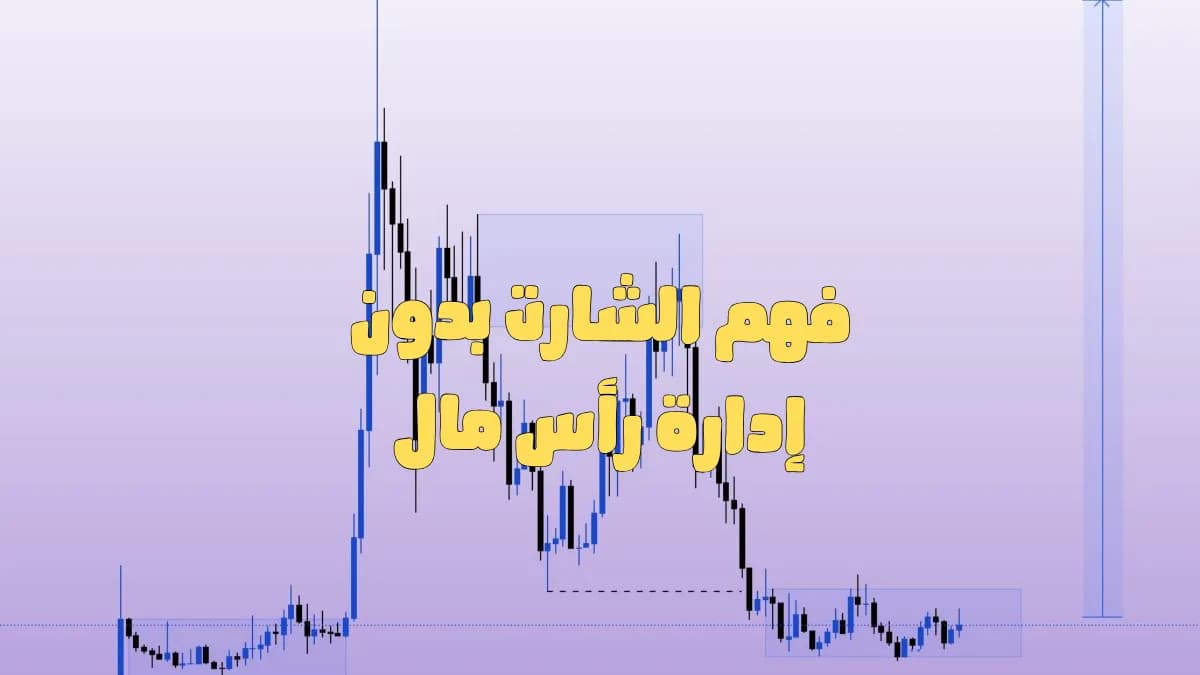
If you open the weekly chart of most assets, you may feel more comfortable than when you look at the lower timeframes.
You’ll find that the bigger picture is often completely different.
Instead of focusing on one or two days of movement, you’ll see that price is moving within a certain range, and what’s happening may simply be an accumulation phase around lower levels after a period of decline.
But the problem starts when you move down to lower timeframes and start following every small move.
Here, the picture changes from a potential opportunity into psychological pressure.
You might see a 50% or 70% move within the range, and start thinking:
“How will I handle this drop?”
“What if I enter now and the price drops even further?”
“What if I lose half my capital before the market starts moving?”
And this is where the important point appears:
Trading isn’t just about knowing where the price could go. It’s also about whether you can withstand the journey until it gets there.
The chart gives you the picture… but your capital determines your ability to wait
A lot of traders focus on one question:
“Will the price go up or down?”
But there’s a more important question:
“If the price moves against me first, will I still be in the market?”
Because you can be right in your analysis, yet still lose the trade because of poor capital management.
Imagine that you analyze an asset correctly, see that it’s sitting around a historically strong area, and expect a significant move higher.
But instead of entering with an appropriate portion of your capital, you enter with all your liquidity.
Then the price drops 30% or 40%.
What happens then?
Your analysis might be correct, but psychologically, you won’t be able to handle it.
You’ll start seeing the loss in numbers rather than focusing on the idea you entered the trade for.
And you may exit before the move you were waiting for even begins.
One of the biggest mistakes traders make is constantly monitoring the market from a low timeframe.
Lower timeframes have their benefits, but they can magnify the move psychologically.
For example:
On the weekly chart, you might see that the price is moving within a clear range.
But when you move down to the hourly chart, you’ll find dozens of small movements:
Strong rally.
Sudden drop.
Fake breakout.
Quick rebound.
If you don’t have a clear plan, you’ll treat every move as if it were a life-changing decision.
And this is where trading starts turning from analysis into reaction.
The market moves, and you move with it emotionally.
One time you enter.
One time you exit.
One time you add to the position.
Then after a while, you discover that the problem wasn’t the market, but the way you were managing the trade.
*The First Mistake: Ignoring Technical Analysis and Relying Only on DCA
There’s a group of traders who say:
“I’ll buy every dip, and eventually the market will go up.”
This is the concept of DCA.
The idea itself isn’t wrong, but the problem starts when you use it without understanding.
Buying assets in stages requires you to know:
What are you buying?
Why are you buying it?
Where are you within the market cycle?
Is the price at an appropriate area, or are you buying during an ongoing collapse?
Some people turn DCA into a way to avoid analysis.
Every time the price drops, they say:
“I’ll buy more. This is a long-term investment.”
But long-term investing doesn’t mean completely ignoring price.
Even an investor needs to understand the asset’s value, market conditions, and the risks involved.
Not every drop is an opportunity.
Sometimes a decline is simply the beginning of a larger move.
On the other hand, there are traders who are excellent at technical analysis.
They know:
Support levels.
Resistance levels.
Trends.
Price patterns.
But the problem is that they enter with positions larger than they can handle.
And this is where the familiar scenario happens:
The analysis says:
“The trade is good.”
But the account says:
“I can’t handle this drawdown.”
And with the first small reversal, fear kicks in.
You start changing the plan.
You close the trade.
Then the price returns in the direction you expected.
The problem wasn’t the analysis.
The problem was the amount of risk.
No single element is enough on its own.
Trading requires:
1- Technical Analysis
So you know:
Where to enter?
Where to exit?
What is the expected scenario?
Without analysis, you’re moving randomly.
2- Capital Management
So you can stay in the market.
Because the best analysis in the world won’t help you if you exit the trade because the loss is larger than you can handle.
Capital management means:
Determining your position size.
Knowing your risk percentage.
Not putting all your capital into a single idea.
3- Psychological Control
Because the market will always test your patience.
You’ll go through moments where you see the price moving against your expectations.
The difference is that a trader with a plan sees this as part of the game.
A trader who enters without a plan sees every move as a disaster.
*Before You Ask: “Will the Market Go Up?” Ask a More Important Question
A lot of people are always looking for a directional prediction:
Will Bitcoin go up?
Will this asset take off?
Is this the bottom?
But the question that should come before all of that is:
“Am I prepared for any scenario?”
Because the market doesn’t give you the perfect path.
Even the best opportunities can go through periods of pressure.
You might see the asset you chose decline before it starts moving higher.
If you aren’t prepared for that, you’ll exit before you get the result you were waiting for.
You might have the best analysis.
You might choose the best project.
You might enter at an excellent area.
But if you don’t manage your capital properly, a good trade can turn into a bad experience.
The market doesn’t reward those who only predict.
The market rewards those who can survive.
So don’t make all your focus about the question:
Where will the price go?
Ask yourself as well:
Because trading isn’t just a race to predict the direction.
It’s a game of survival.
And the trader who protects their capital is the one who gets the chance to benefit when the move they’ve been waiting for finally comes.
Available next action: Create a downloadable DOCX file here in this chat containing the editable prose above