
Risk/Reward Ratio: How a Late Entry Changes Your Trade
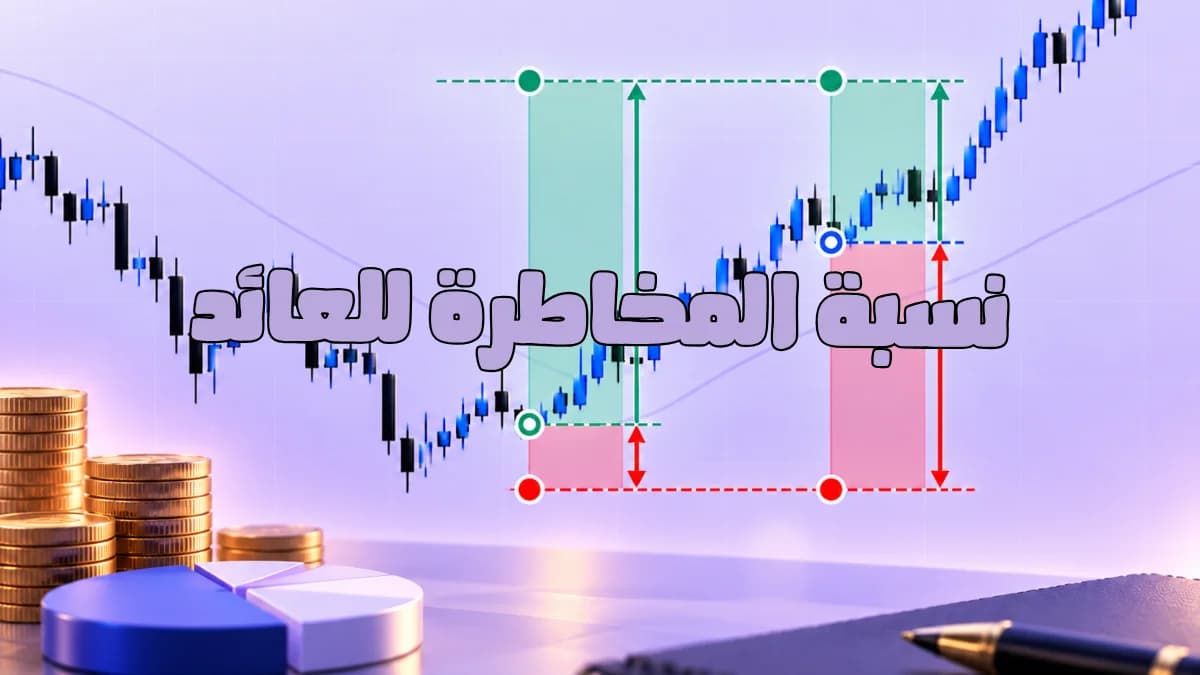
Imagine the price has moved away from the area you were watching without giving you the confirmation you needed to enter at the right place. You still see an upward direction. Does that mean you can enter anywhere, as long as your analysis has not changed?
The direction can remain the same and the price can keep rising toward your expected target, while the trade calculation changes.
The closer your entry gets to the target and the farther it gets from the stop, the smaller your potential reward becomes relative to the loss you would take.
That is why you need to calculate risk/reward from your actual entry price, not the area you missed.
What is the risk/reward ratio?
Simply put, it compares the loss you plan to accept if your stop is hit with the profit you aim for if the price reaches your target. If you risk $1 to target $3, we write the risk-to-reward ratio as 1:3.
Keep the same stop and target
Suppose the planned entry was $100, the stop $95 and the target $115.
Risk per share or coin = 100 − 95 = $5. Targeted reward = 115 − 100 = $15. Each dollar of risk has $3 of targeted reward; here we write that as 1:3 RR, risk to reward.
Now you are late, and the price is $110. If the technically justified stop is still $95 and the target is still $115, the risk is $15 and the remaining reward is just $5. The ratio is approximately 1:0.33 RR.
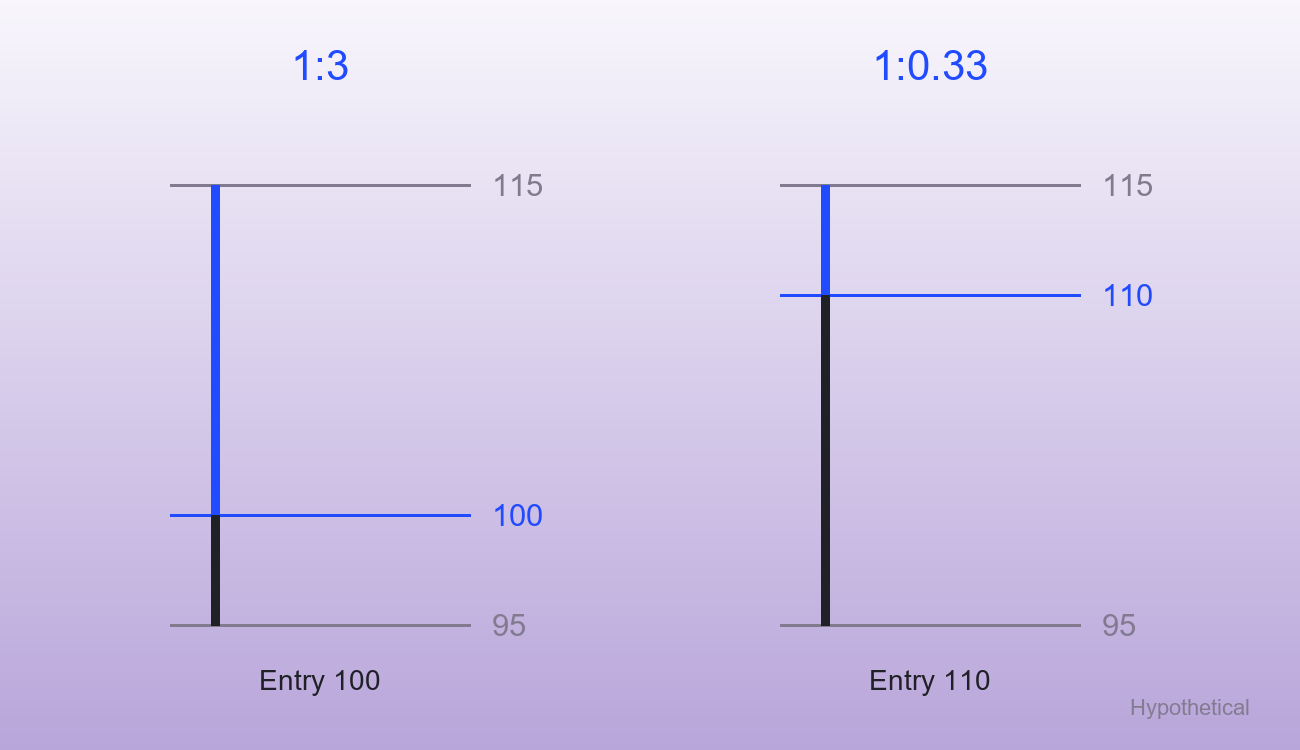
Same direction, same target, but a completely different trade. Even if the price rises from $110 to $115, that does not change the calculation available to you at entry.
What if I just reduce the quantity?
Reducing quantity can reduce your dollar loss, but it does not repair the risk/reward ratio.
At the original entry, one share or coin risks $5 for a targeted reward of $15.
At the late entry, one-third of a unit also risks $5, but the targeted reward is only about $1.67.
You brought the planned loss back to the same amount, but the reward fell. Review size and ratio together: they answer different questions.
Do not change the target or stop to improve the displayed ratio
You might think: I will raise the target to $140 or move the stop closer, and the ratio will look good.
What new evidence on the chart justifies that? Without it, you are changing numbers to justify entering. Your target needs a reason within your method, and your stop should reflect invalidation of the idea. They are not lines to move until a drawing tool displays a ratio you like.
If a new entry setup appears with its own conditions and a closer stop, assess it as a new opportunity. Do not treat it as the original trade just because the direction is the same.
Does 1:3 mean a guaranteed trade?
No. The ratio compares a planned loss with a targeted reward. It does not tell you the probability of reaching the target. A distant target may produce a large number on the chart without being suitable for the setup’s conditions.
Your review needs to ask: under what conditions does the setup occur? How consistently do you follow its management rules? How often do your applications actually reach the reward you target? A large ratio alone does not answer those questions.
Read about FOMO and the difference between analysis and the decision to enter if you keep recalculating every time you see a rising candle just to catch the move.
Update the numbers before chasing the price
Write down the entry available now, the stop and the target. Calculate risk and reward per unit. Then check whether the opportunity still matches your setup conditions and limits, and calculate the appropriate quantity if it does.
If the opportunity is no longer suitable, waiting for a new setup has a reason behind it. The market continuing without you does not mean you had to enter. Assess the trade you can execute now, not the one you wish you had entered earlier.
Do not forget to explore the professional entry setups I teach in the learning path, featuring high win rates and risk/reward ratios.