
Is Technical Analysis a Scam? Bebo’s View on Its Value and Limits
Let me share a view based on my experience and the years I have spent studying charts.
Nothing in financial markets is guaranteed to work 100% of the time. Every trading method has losing outcomes, whether it relies on technical analysis, fundamental analysis, mathematical models or artificial intelligence.
The real difficulty with technical analysis is that not all its rules are explicit enough for everyone to apply them with the same consistency. I could explain an entire school of analysis and share all the rules and concepts I use, yet you might not get the same results when you apply them to a chart.
Why learning the rules is not enough
Why does that happen? There is also the experience you acquire from studying charts: an understanding of price behavior and market psychology that develops through practice, observation and trial over the years.
In my view, technical analysis is an art with rules and foundations. Studying those foundations does not automatically mean you have mastered it.
What are the different schools of analysis built on?
If we look at the origins of technical analysis, much of it began with observing price movements and identifying recurring behavior and patterns on charts. Classical analysis, time-based approaches, numerical approaches and more recent schools all attempt to understand market behavior and establish rules for dealing with it.
Does that mean every school of analysis is correct? No. Can everyone who studies charts develop useful rules and successful setups? Again, no.
But struggling to master a particular approach, or being unable to translate every part of it into a mathematical program, does not by itself mean that the approach has no value.
Examples from my own chart-reading experience
That brings me to a more important question. If technical analysis has no use at all, how do we explain cases in which technical analysts, including myself, identified market moves in advance? These are examples, not a complete record.
Saudi Arabia’s Tadawul All Share Index (TASI)
Months in advance, I had identified price areas and targets based on technical analysis, including order block areas from which I expected a decline. At that time, I did not know what political decisions or events might occur months later, nor did I need to know them to build that scenario.
The Egyptian stock market
The same applies to cases in which we anticipated a decline from the chart before the events and decisions that people later associated with that decline became apparent.
Bitcoin and cryptocurrencies
There have been multiple upward and downward scenarios, and price areas I identified before the market reached them and subsequently reacted around them.
How could I, or another analyst, identify those possibilities without relying on news or economic releases? Does that mean I know the future? Certainly not. Do all my analyses work? No. Some have failed, which is normal for any trading approach.
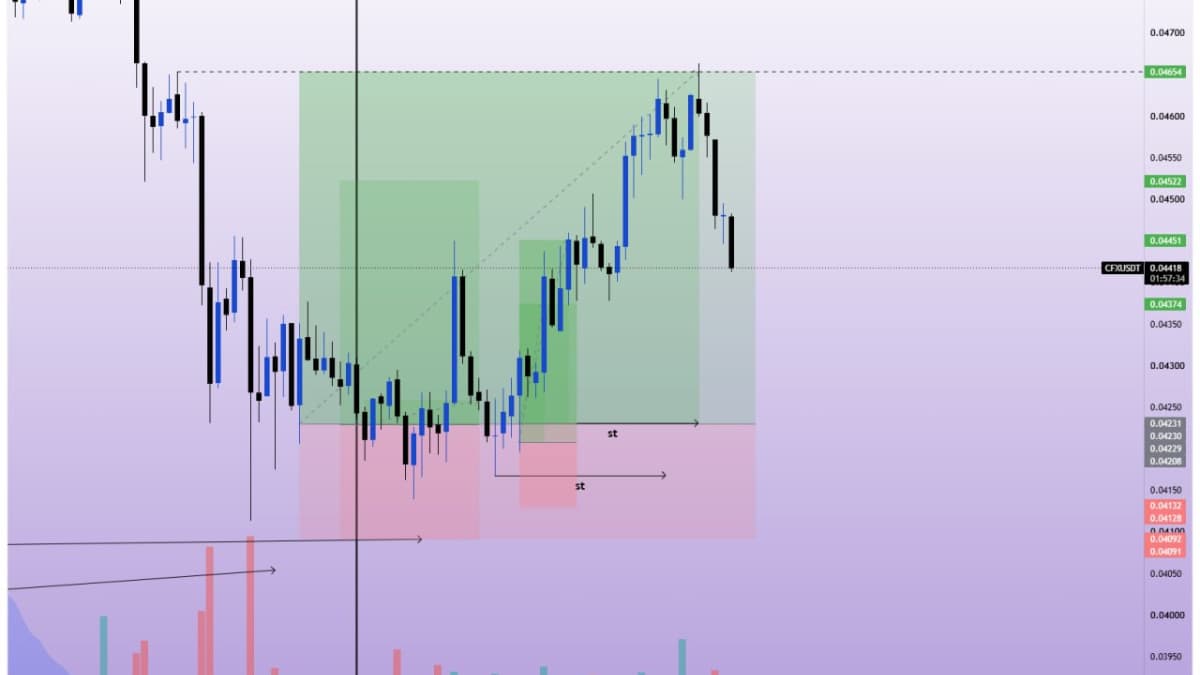
After years of studying charts, developing a repeatable way to identify important price areas, testing the resulting entry setups and measuring both their successful and unsuccessful outcomes, I have practical reasons to see value in technical analysis. These are the setups I work on.
Showing a few successful forecasts is not enough to prove that a method works. It does, however, point to an experience that deserves study and evaluation rather than automatic dismissal.
Technical analysis and fundamental analysis
I am not against fundamental analysis. It matters, and there are specialists who use it effectively. But I do not want to speak with the same authority about an area in which I have less experience than I do with technical analysis.
I am discussing the approach I have spent years studying, applying and testing myself. Political and economic events can accelerate a price move or change its direction. That does not mean we cannot study possible price behavior on a chart before a particular news event appears.
Why do some people call technical analysis a scam?
Unfortunately, part of the problem is the behavior of people presenting themselves as technical analysts without sufficient experience. Someone draws a couple of lines without understanding what they represent, then waits for the price to move.
If the scenario works, they return with “I told you so” and congratulations to anyone who benefited. Then come VIP subscriptions, paid signals and promises of turning small accounts into millions. If the analysis fails, it disappears from the conversation.
For many people, that becomes their entire picture of technical analysis. But the fact that some people exploit it for deceptive marketing does not, by itself, show that technical analysis is useless.
You may be a very successful trader using another method, and that deserves respect. Success with one approach does not establish that every other approach must fail.
You can argue that technical analysis is difficult and takes substantial experience and practice. You can say that another method is easier or better suited to you. But calling every technical analyst a fortune-teller is, in my view, an unfair judgment when it is based on social media behavior rather than an examination of different methods and the records of those applying them.
How can you evaluate a trading method for yourself?
I am not asking anyone to accept technical analysis simply because I use it or because a particular forecast worked.
My advice is to learn, understand what you are doing, work on charts yourself and backtest. Define clear entry setups, then examine their win rate, reward relative to risk and frequency of occurrence.
You do not need to be right every time for a trading approach to be profitable. You need an approach with a genuine long-term edge and risk management that protects your capital.
My view on technical analysis
Technical analysis combines knowledge, experience and practice. Memorizing its rules does not automatically produce results. Someone failing to understand or apply it is not, on its own, evidence that technical analysis itself has failed.
Wishing everyone the best. 💜
To start learning and applying these ideas, explore the WolfCharts trading learning path.