
Are You the Trader, or the Liquidity the Market Is Looking For?
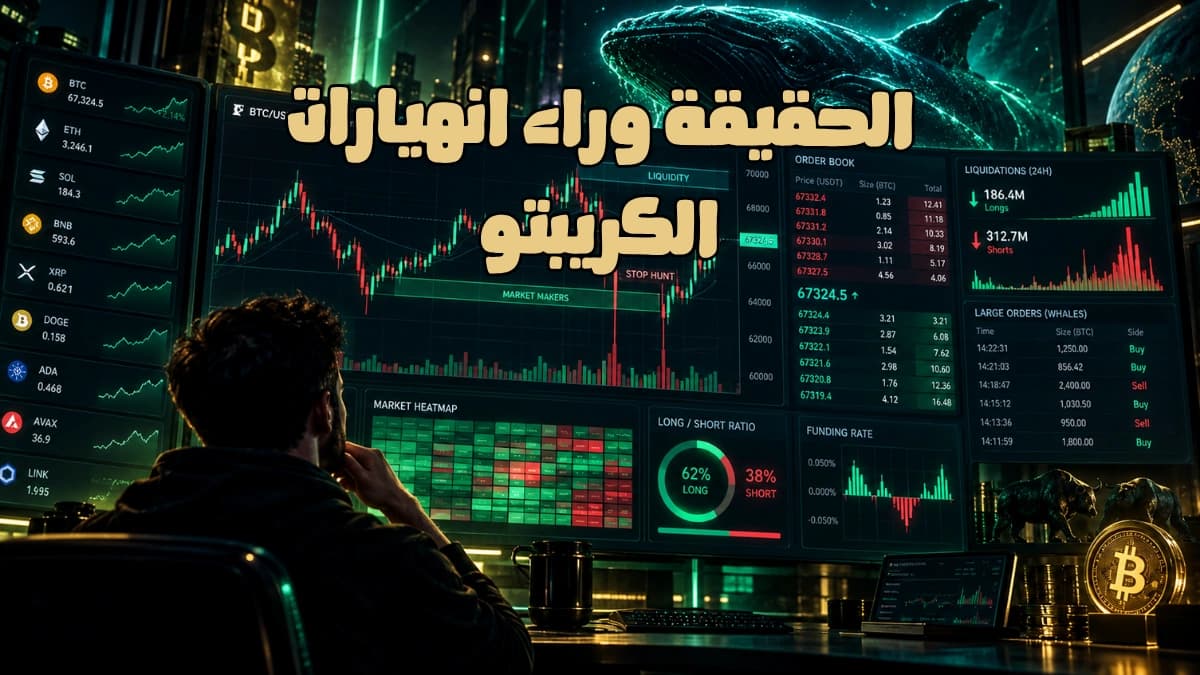
Most people enter the trading market looking at the picture from only one angle. The trader sees price moving up and says, “The opportunity is here, I have to enter,” and sees the market crashing and says, “This must be the end of the trend.” But very few ask the most important question:
Who is on the other side of the trade, and why did the market move this way?
Because trading, in the end, is not just about drawing lines on the chart or looking for an entry signal.
The market is a constant battle for liquidity.
Every trade you enter has another party on the other side, every buy or sell order has an impact, and every place where traders place their orders becomes an area of interest for those who have the ability to move the market. And this is where the real picture of understanding crypto, futures, and high-risk markets begins.
The Market Doesn’t Move Randomly as Some People Believe
Many traders treat the market as if it moves randomly.
One candle goes up, another goes down, a piece of news appears, and the market moves. But behind these moves, there is something fundamental driving the game: liquidity.
Liquidity is the fuel the market needs to move. When thousands of traders place stop-loss orders below a certain level, or open short or long positions at an obvious area, that region becomes filled with orders, and these orders represent liquidity ready to enter the market.
That is why we sometimes see price move against the majority’s expectations, reach a certain area, hit the stops, and then start moving in the direction people expected from the beginning.
A trader who doesn’t understand liquidity thinks the market tricked him. But a trader who understands liquidity movement knows that these areas were not random.
Why Have Mass Liquidations Become Such a Clear Phenomenon in the Crypto Market?
The crypto market, especially together with the futures market, has made this even more obvious.
Leverage allows traders to open positions much larger than their actual capital, and this is where the problem begins.
The higher the leverage, the shorter the distance between you and liquidation becomes.
A small move against you can turn into a very large loss. And at certain times, when a large number of traders are positioned in the same direction, their clustered orders become an obvious target for market movement.
That’s why we sometimes see very strong moves within a short period of time:
A sudden rise followed by a sharp drop.
A break of an important level followed by an immediate return.
Huge numbers of traders getting liquidated within minutes.
These moves make many people feel that the market is deliberately targeting them. But the most important truth is that the market is always looking for areas containing the largest amount of liquidity.
Whales Are Not All at the Same Level
When a trader hears the word “whales,” he imagines one person or entity controlling everything. But the picture is more complicated.
There are different levels of participants in the market.
There are retail traders, institutions, funds, and entities with massive liquidity. But even those with large amounts of capital are not always in control. Someone with millions may find themselves facing a player with greater data, capabilities, and liquidity.
In other words:
Even whales can have liquidity that is targeted by larger whales. And this explains some of the violent moves that happen in the markets. The market is not simply beginners losing to professionals. Sometimes, a large player loses to an even larger player.
Technical Analysis Evolved Because the Market Evolved
Over time, modern schools and methods of analysis emerged to understand these movements more deeply, such as:
Smart Money Concepts (SMC).
Inner Circle Trader (ICT).
Liquidity zone analysis.
Tracking price behavior around areas of interest.
The core idea behind these approaches is not that the market wants to punish a specific person, but rather to understand where large orders are located and where price may move in search of liquidity.
A trader who relies only on candle patterns or a single indicator often sees only a small part of the picture.
But a trader who thinks about:
Where is the liquidity?
Where are traders’ orders?
Why did price reach this area?
starts reading the market differently.
No Analysis Can Prevent Losses 100% of the Time
This is where many people make a major mistake. They look for a strategy that never loses, search for someone who gives them guaranteed entries, and wait for the magical indicator that makes every trade profitable. But that doesn’t exist.
Even the best traders in the world have losing trades.
The real difference is not in preventing losses. The difference is in making your losses calculated and making your profits, when they come, capable of compensating for them. And here we find the factor that most traders ignore: capital management.
Capital Management Is the First Line of Defense
You may have excellent analysis and correctly identify the trend. But if you enter with a position size larger than you can handle, one wrong trade can wipe out the results of weeks or months.
A professional trader doesn’t only ask, “How much will I make?”
They ask first, “How much can I lose?”
Because the first goal in trading is not hitting a lucky trade. The first goal is survival.
Those who stay in the market for a long time have the opportunity to learn and improve. But someone who enters with all their capital in one trade because they believe they found the golden opportunity is giving the market a chance to end their journey quickly.
The Biggest Mistake Is Thinking the Platform Is Your Friend
There is a common idea among some traders that the platform or the person promoting it only wants you to succeed. But you need to understand how things work.
Any platform or broker is ultimately a business with its own business model and objectives. And someone promoting a platform often has an interest connected to that promotion. Therefore, don’t let your trust in an advertisement or a person be the reason you enter a market you don’t understand.
Don’t enter because someone told you that you will become rich quickly, and don’t believe anyone who portrays trading as an easy path without learning and discipline.
Trading Is Not a Get-Rich-Quick Path
You are entering one of the most difficult areas of finance, especially when we are talking about markets like crypto and futures.
The problem is not only price movement. The problem is also the trader’s psychology.
Fear
Greed
The desire to recover losses quickly
Overconfidence after a winning trade
All of these things can sometimes make the trader their own biggest enemy. That is why success in trading doesn’t depend only on knowing where to enter. It also depends on your ability to control yourself and manage risk.
Always understand, my fellow trader, that...
Always understand, my fellow trader, that...
The market is not looking for a specific person to lose, but it always moves around liquidity.
A trader who doesn’t understand this idea will continue to see losses as surprises or manipulation. But a trader who learns to read market movement, understand liquidity areas, and use the right analysis alongside strong capital management will see the bigger picture more clearly.
Always remember:
You don’t enter the market to prove that you are right.
You enter the market to manage risk and keep going.
Because trading, in the end, is not a race to see who makes the biggest profit in a single trade... but a race to see who can stay in the market longer and learn from every move.