
Liquidity Sweep: Why Price Hits Your Stop and Then Reverses
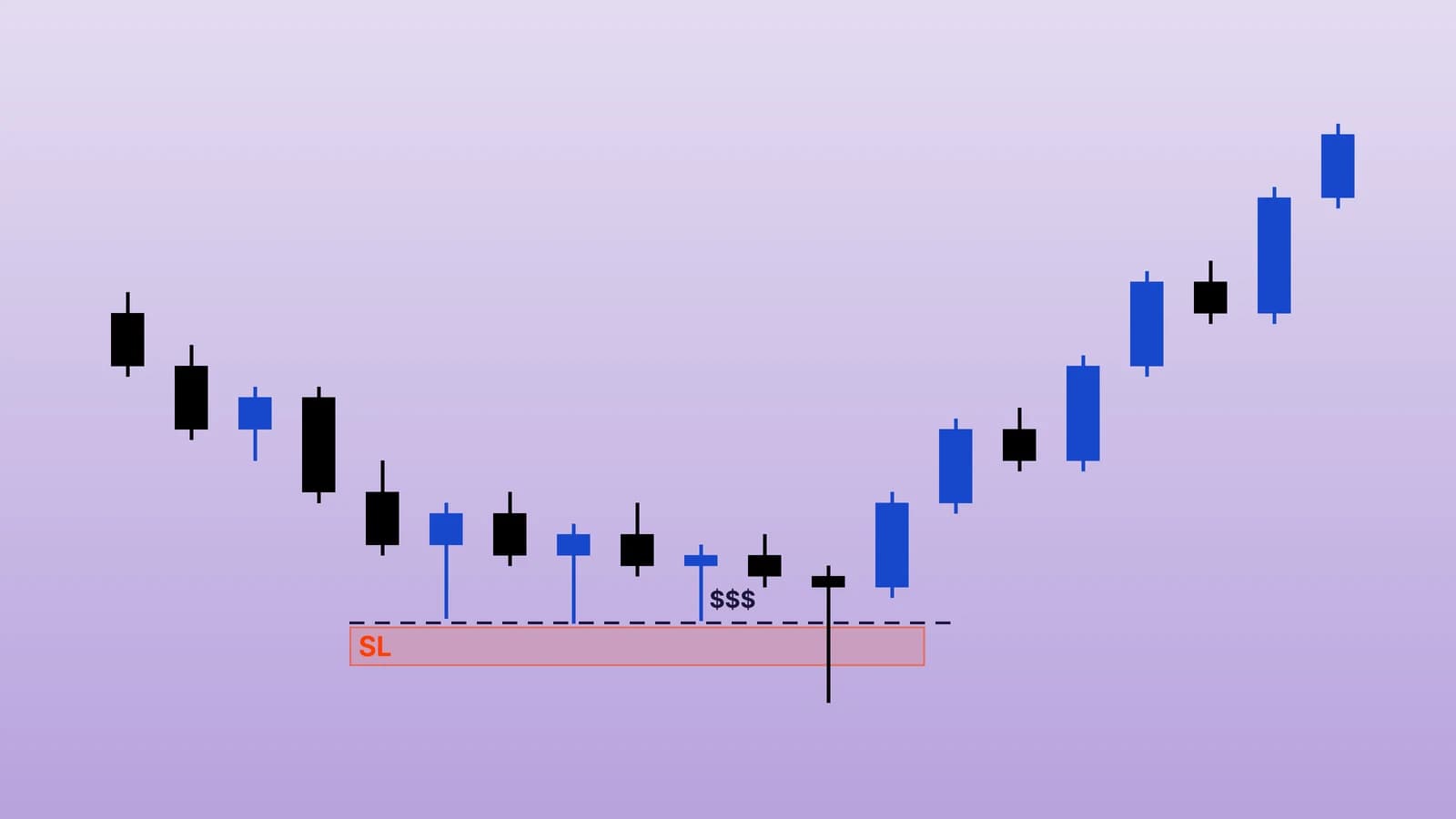
How many times have you entered a trade confident in your analysis, only for price to drop, hit your stop loss by a few pips, and then shoot straight in the direction you expected?
You close the platform thinking: "The market is against me," or "My broker can see my orders."
The truth is simpler than that, and more important.
The market isn't targeting you personally.
The market moves to where the orders are.
And stop-loss orders are one of the biggest sources of orders on any chart.
In this article, we'll look at why this happens, what it looks like on the chart, and how to place your stop in a way that reduces how often it gets hit for no good reason.
Where do most traders place their stop loss?
Ask ten beginner traders where they put their stop on a buy trade, and most will say: just below the last low, or slightly below the support line.
On a sell trade: just above the last high, or slightly above resistance.
That's what most of us learned at the start, and it looks logical. The problem is that thousands of traders think the same way, so thousands of orders end up stacked in almost the same place.
That cluster has a name: liquidity.
Why does price go there?
Think of price as a car that needs fuel to move. The fuel here is orders.
Large players can't enter huge positions at any moment, because they need someone on the other side: someone to sell to them when they want to buy, and someone to buy from them when they want to sell.
A stop loss on a buy trade is actually a sell order waiting to be triggered. So when price drops below an obvious low, all those sell orders fire at once, and the size the large buyer needs becomes available at a better price.
Once price has collected that fuel, there's no reason for it to stay down, so it turns and continues in its direction.
That's why it feels like the market "hit your stop and then left." It wasn't looking for you. It was looking for the orders sitting around your stop.
What does it look like on the chart?
In Smart Money Concepts, this move is called a liquidity sweep. Its typical shape:
A candle breaks the obvious low with a long wick.
It then closes back above it, or price returns above it within a few candles.
After that, the direction shifts on the lower timeframe, which is called a ChoCH (Change of Character).
The difference between a sweep and a real break matters a lot:
In a real break, the candle body closes below the low, and price keeps falling and prints lower lows. That's a BOS (Break of Structure).
In a sweep, the break usually happens with the wick, and price refuses to stay below the level.
Not every break of a low is a buy signal, and not every break is a continuation signal. The right read comes from how price behaves after the break, not from the break itself.
Sometimes the market also builds a small "bait" low before the important zone, to collect the orders of traders who entered early. That's called inducement, and understanding it can save you a lot of trades.
How do you place your stop loss more intelligently?
Don't put your stop in the most crowded spot. If a low is obvious to you, it's obvious to everyone else. Instead of placing your stop right below it, ask yourself: has the liquidity below this low been taken yet? If not, there's a good chance price visits it before it moves.
Wait for the sweep, then enter after confirmation. Instead of entering before the move, wait for price to break the low and come back, then look for a change in structure (ChoCH) on a lower timeframe. Your stop then sits below a low that has already been swept, which is a more logical place.
Calculate your position size from your stop distance, not the other way around. Many traders keep their stop very tight because they entered with a large size and can't afford a wider stop. The right way is to first decide where your analysis would be wrong, then size the trade so the loss stays within a fixed percentage of your capital.
Don't widen your stop after entering. If price gets close to your stop and you move it further away "to give it room," you're no longer managing a trade. You're postponing the loss and making it bigger.
Does this mean your stop will never get hit again?
No.
Nothing is guaranteed in trading. Your stop will still get hit sometimes, wherever you put it, and that's a normal part of any trading system.
The goal isn't to never lose. The goal is to stop paying the price of placing your stop exactly where price tends to go before it moves.
Summary
The market isn't chasing you.
It moves to where the orders are, and an obvious stop loss is one of the biggest clusters of orders.
Once you understand where liquidity builds up, you stop being the fuel that moves price, and you start entering after that fuel has been used.
If you want to learn liquidity and market structure step by step from scratch, start the course on the site, and take the level assessment first so you begin at the stage that fits you.